By Laura Farmer
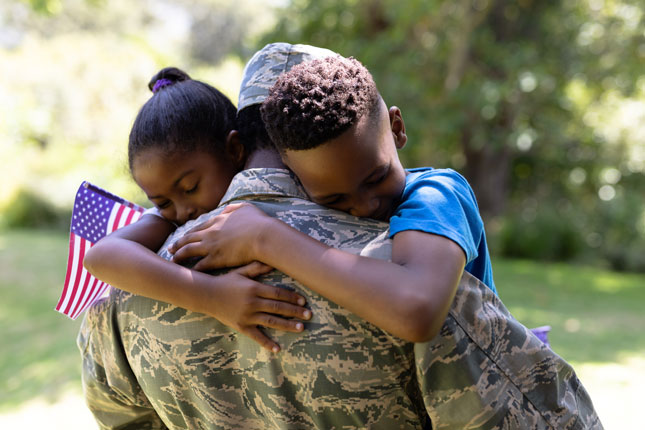
The families of America’s military service members face unique pressures: frequent moves, deployments of one or both parents, and the stress of serving in dangerous environments. Providers who care for these families must be especially resourceful to meet their needs—wherever they are.
That’s the mission of Kennedy Krieger Institute’s Behavioral Health Services for Military Families, founded in 2011 within the Institute’s Behavioral Psychology Department. One of the Institute’s Behavioral Psychology Outpatient Programs, the program is based in Odenton, Maryland, near the U.S. Army’s Fort Meade installation, and it offers behavioral healthcare at multiple Institute locations and through telehealth. The program also offers training to postdoctoral fellows in providing care for military-connected patients and families.
“Our program began near Fort Meade, so our early focus was on serving that community—both on and off the installation,” says psychologist Dr. Jennifer L. Crockett, the program’s director. Dr. Crockett’s husband served for more than two decades in the U.S. Army, so she understands firsthand the challenges and culture unique to military life. The team credits her experience and passion as key drivers of the program’s effectiveness.
“Military life has its own language, and Jen knew we needed that fluency to best serve our service members and their families,” explains psychologist and program coordinator Dr. Michelle Bubnik-Harrison.
“When military families come to Kennedy Krieger, we never pretend to know what it’s like to walk in their shoes,” Dr. Crockett adds. “But we want to make sure they don’t have to start from scratch, explaining what it means to be a military family, their stressors and strengths, and their resources.”
We focus on building resilience—we help prepare kids and teens for whatever challenges lie ahead.” – Dr. Michelle Bubnik-Harrison
Local Care, Delivered Globally
In 2015, the program launched one of the Institute’s first telehealth programs, a highly innovative approach at a time when few providers offered virtual care.
“We were among the first to test telehealth in the homes of military families—five years before the pandemic,” Dr. Crockett says. “Our small team paved the way, creating the infrastructure the Institute needed.”
Today, the team has made a name for itself as a pioneer in best practices for serving military families, setting a model for other providers. Team members work hard to connect families to care as quickly as possible.
“These families move far more often than typical families do, and combined with waitlists, that creates major barriers to care,” explains psychologist Dr. Sara Hinojosa. Recent licensure changes have enabled the team to continue to serve families even after families move. “I recently met a mom who was in tears because, just as they finally found care for their son, they were moving again. When I told her I could keep seeing them in their new state, she cried with relief. Moments like that show how deeply mobility impacts military families.”
Dr. Bubnik-Harrison echoes that frequent relocations can be stressful for children and teens. “Moving during high school can be especially tough. They’re trying to break into social networks that are already established, and even when they return to a place they’ve lived before, friendships may have moved on while they were away,” she says. “Some adjust quickly and form strong networks, but for many, the constant cycle of reestablishing relationships can be really hard. In behavioral psychology, we focus on building resilience—we help prepare kids and teens for whatever challenges lie ahead.”
A Resilient Force
While the team acknowledges the challenges that military families face, they also champion the many strengths of the military community. Psychologist Dr. Jaime Benson, the program’s Maryland liaison, serves on the board of the Fort Meade Alliance, an independent community organization. She is passionate about developing community partnerships that help connect military families to Kennedy Krieger’s services.
“Through the Fort Meade Alliance, we’ve helped develop resources like the Resiliency Services portal—a hub of vetted tools for families, from mental health to financial and spiritual support,” she explains. “We’ve also partnered with groups like Blue Star Families to strengthen social connections, as we know that support networks are critical for resilience. Getting involved in programs like Blue Star Families’ START [Serving, Thriving and Reading Together] Book Program, where military and civilian families come together around reading, is one way we can stay connected and embedded in the community.”
In fact, Dr. Benson created a community event last April to celebrate the Month of the Military Child. Hosted at the local library, the event welcomed children from military families to complete free crafts and even work with an improv specialist to help them talk about their experiences.
Another helpful tool developed within the Behavioral Psychology Department is the Military Families Digital Parenting Program, which can be accessed asynchronously. These behavioral lessons not only are convenient, but also help families overcome the stigma sometimes associated with seeking mental healthcare.
“Although military families face significant challenges, they can lean on military and community supports that help build resilience,” Dr. Crockett says. “Kennedy Krieger is proud to help foster that strength.”