
By Laura Farmer
For the past three decades, neurodevelopmental pediatrician Dr. Mary Leppert has welcomed medical trainees to Kennedy Krieger Institute’s Department of Neurology and Developmental Medicine, creating hands-on learning opportunities while seeking to alleviate the shortage of clinicians in the U.S. trained in pediatric neurodevelopmental disabilities.
But ensuring the department’s trainees are fully up to speed in this particular field while continuing to serve the department’s patients has always been a challenge.
“We work with about 250 trainees a year, and for a long time, they were cycling through without a clear learning plan or structured teaching,” Dr. Leppert explains.
And so in 2012, she and developmental neurologist Dr. Joanna Burton, who co-directs the Institute’s Infant Neurodevelopment Center, decided to tackle the problem. They created a yearlong NICU curriculum through Johns Hopkins Medicine’s Institute for Excellence in Education and piloted an online learning platform, giving trainees a shared baseline of knowledge and allowing instruction to be tailored to each learner.
The Institute has an incredible depth of knowledge, and that brain trust is what makes a curriculum like this possible.” – Dr. Mary Leppert
Four years later, the curriculum expanded into a module for Project ECHO® (run by The University of New Mexico), a hub-and-spoke model of delivering specialty knowledge to local providers. The Institute’s ECHO team, which included Dr. Leppert and behavioral psychologist Dr. Nancy Grace, child and adolescent psychiatrist Dr. Joyce Harrison, and neurodevelopmental physicians Dr. Deepa Menon and Dr. Anna Maria Wilms Floet, developed a multilevel program consisting of 10-to-15-minute online lectures on autism, communication disorders and disruptive behaviors.
“It was a more formal version of what my colleagues and I were teaching in the clinic,” Dr. Leppert explains.
More recently, the team has designed a proprietary program for Kennedy Krieger to share with trainees and providers across the country and around the world: Kennedy Krieger Instruction in Neurodevelopmental Disorders—KIND for short. It’s a series of video-centric learning modules, each about 15 minutes long and covering specific topics pertaining to neurodevelopmental disabilities in children and teens. Each module builds on the previous one, starting with general information about different conditions and leading to more specific guidance on evaluation, diagnosis and treatment.
KIND consolidates just a fraction of the knowledge of Kennedy Krieger’s faculty and staff into a single repository. The content is made visually interesting, accessible and polished by the Institute’s Learning Design and Technology Team, led by Dr. Eric Moore, and is edited by Dr. Leppert, Dr. Harrison and pediatric neurologist Dr. Megan Bone.
But it’s not just medical professionals who benefit from this valuable learning approach.
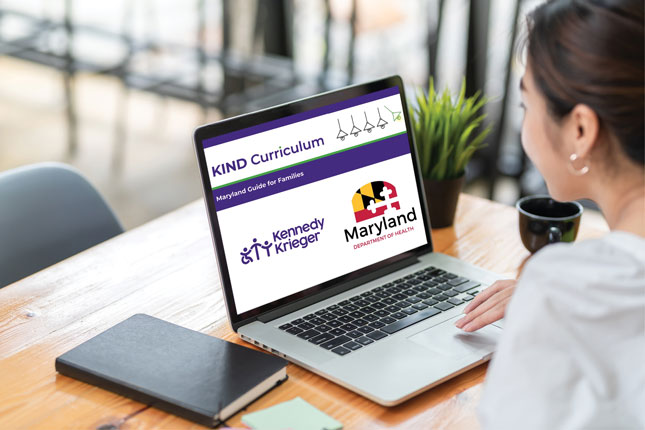
“Our team kept saying, ‘This information is just as important for parents,’” Dr. Leppert says. In 2025, with support from the Maryland Behavioral Health Administration, Kennedy Krieger launched the Maryland Guide for Families of Children with Disabilities, a version of KIND for families. This free, public course leads families through the journey of diagnosis, healthcare, education, family dynamics, legal considerations and the transition to adulthood.
“I’m especially proud of this course because it brings the Institute’s extraordinary expertise directly to families in a practical, nuanced and deeply needed way,” Dr. Leppert adds. “The Institute has an incredible depth of knowledge, and that brain trust is what makes a curriculum like this possible to serve local families and ultimately help clinicians worldwide achieve the best outcomes for their patients.”