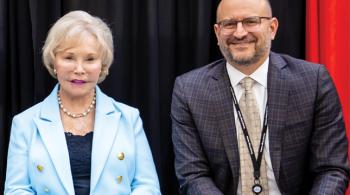
Dr. Theresa Nguyen, pediatrician and host of the "Practical Parenting" podcast, joins Dr. Brad Schlaggar this month to talk about the state of youth mental health. Recent research reveals that kids are more anxious or depressed than previously reported and are even considering suicide more frequently than parents might know. Dr. Nguyen and Dr. Schlagger share advice for talking about these tough topics with the children in your lives.
Dr. Brad Schlaggar (BS): Welcome to Your Child's Brain, a podcast series produced by Kennedy Krieger Institute with Assistance from WYPR. I'm Dr. Brad Schlaggar, pediatric neurologist and President and CEO of Kennedy Krieger Institute. Today's topic is a heavy one, but it's a critically important topic to address, and I have a guest with me today who is expertly qualified to help us navigate this space. We're going to talk about pediatric mental health and in particular suicide prevention. Over the past few years, Kennedy Krieger has embarked on a significant effort to screen our patients, ages eight and older for mental health concerns, even if that child's appointment with us is not for a mental or behavioral health concern specifically. The data we gathered supports similar research that has emerged nationwide, that children are more anxious and depressed than had previously been realized and or discussed, and that talking about these concerns is important. What our clinicians also demonstrated is that children with neurodevelopmental disorders and disabilities, in general, can be at even greater risk for significant mental health issues, including suicidal thoughts or ideations when compared to their neurotypical peers. That observation should not be surprising. As we've discussed often on this podcast, neurologic, psychiatric, and psychologic conditions are all manifestations of brain function. What are the numbers around risk? According to the Centers for Disease Control and prevention, one in five children ages 3-17 have been diagnosed with a mental, emotional, or behavioral health condition. Anxiety and depression are among the most common. Forty percent of teenagers, ages 12-17 reported persistent feelings of sadness or hopelessness in the prior year. In that same age group, teenagers 12-17, 20% of respondents said that they had seriously considered attempting suicide during the previous year. That's a lot of sobering information to digest. But there's more to this topic than the statistics, and there are a lot of resources, including conversation starters for parents and others who want to support the children in their lives. Joining me today to discuss pediatric mental health as Dr. Terry Nguyen, Chair of Pediatrics at the Greater Baltimore Medical Center, and a part time Assistant Professor of Pediatrics at Johns Hopkins University School of Medicine. Dr. Nguyen is also co chair of the Mental Health Committee for the Maryland Chapter of the American Academy of Pediatrics. Like me, she gets to be a WYPR podcast host. Her monthly podcast is called Practical Parenting. I had the privilege of being on her show in April to discuss parenting a neurodiverse child. Terry, we had such an interesting conversation, I'm really pleased we have the chance to talk again and about such an important topic. Welcome to the show.
Dr. Terry Nguyen (TN): Thank you, Brad. Thank you for having me, and it's a pleasure to see you again.
BS: Likewise. Since this is your first time on Your Child's Brain, although the audience may be very familiar with you from Practical Parenting, could you share a bit about your background? Why you decided to become a pediatrician, and what ultimately brought you here to the Baltimore area?
TN: It is a windy road, and I think windy roads are the best for life. You get to live life the fullest. I was born in Vietnam. I came to the US in 1975. You might have remembered that war, and I was six-years-old. Part of the reason I went into medicine was that our family had such a great experience with sponsorship in America with the kindest family. That led me wanting to do medicine, and I came down to Baltimore for the first time for undergrad. I was a biomedical engineering major at Hopkins, and then I went back to New York for med school. I thought I was going to do geriatrics because that was an area of great need. Then I did my rotation in geriatrics, and I was scared witless. Too many medications, too many interactions, and people really having a very difficult time making lifestyle changes. That's where I turned 360 degrees, I think, and started to go with pediatrics. I came back to Baltimore to do my residency at Hopkins and then a fellowship. I landed at GBMC because I done something else in my curvy life that I didn't like very much, health policy. Then I've been here. I've discovered in this journey that I really like adolescents, and I really enjoy helping them with their mental health. I call it mental fitness rather than just mental health, mental fitness. We have physical fitness, we have mental fitness.
BS: In your practice, what have you noticed about children today and their mental fitness, both from the children's perspective and also the parents perspective?
TN: I've been in practice for almost 30 years, and I will say, there's been a significant increase in anxiety symptoms in children, but I think it's probably also their parents. You share the statistics already, so I won't belabor that. But you said one in five children and adolescents exhibited some mental health symptoms such as anxiety or depression or even some thoughts of suicide. It's very true. When I first started practice many years ago, I only saw anxiety and depression in my teenagers, like high school-ish. Now I am over 25 years. I'm seeing anxiety even in my elementary school age children. Depressive symptoms even in late elementary starting in middle school. I find that the difficulty, what used to be when we were growing up, Brad, our difficulty was, I believe, high school years. That's really when you're coming out on your own and discovering who you are, and those peer relationships can be stressful. But I now see it really my middle schoolers, and what had been challenging social relationships is starting much earlier. There's so much pressure for children and parents to achieve, they are mirroring off each other. They're bouncing back and forth. Parents anxiety about achievement for their child, reflects off their children, and then their children are feeling that angst and becoming more anxious. It's dual rolled here.
BS: You're really addressing this concept of a generational shift in the clinically evident prevalence of mental health concerns. It sounds you're positing that it's not just a question of increasing recognition, that it's being unmasked because we're asking the questions more. There's a real quantifiable change. If you dive a little bit deeper in what you think may be the drivers for this increased prevalence of mental health issues.
TN: Let me anchor that with some data from the CDC. From 2016-2023, overall mental or behavioral health conditions in youth rose by 35%, diagnosed anxiety jumped by 61%, and depression rose by 45% in those seven years, 2016-2023, alarming. I think that the pressures for achievement are coming earlier, and by achievement, I mean academic achievement, extra curricular achievement, meaning it can be sports, it can be music, it can be the arts, and there is this sense of urgency in parents. If I don't get my kid into the right school from the very beginning, they won't have all the opportunities, and if they're not at the top of whatever their extra curricular, they won't be a top candidate for the college and the career that they want. That angst from parents, that they want to be able to help their children "live their best life and be happy" I'm putting that in quotes, may drive some parents to pushing a little bit more or getting rid of any obstacles for their children, any obstacles to their success. I get it. When our children are younger, we want to keep them from having accidents that could injure them. But it's not the same when it comes to challenging or difficult situations. Because both you and I know from a brain perspective, how we learn and how we grow in our brain is that we get a challenge and we problem solve it, and it has to be age appropriate. You need to have some frustration to push through, but not such a high level of frustration that you give up. But if parents are getting rid of all the obstacles in your way, you'll never learn how to problem solve on your own. When you are finally faced with adversity, whatever point of life that is, you melt or have tantrum, like as if you were a toddler, except now you're a teenager or you're a young adult.
BS: It's such an excellent point. This concept of frustration tolerance and boredom tolerance, they're not just semantic constructs. They're real, they're important parts of the experience for a child growing up. To be prepared for the life that's in front of them, that is probably the effects of sociocultural changes in the real world. That's the downside, I think, but there's also perhaps some upsides. Are there some areas where you think children today are flourishing in ways that perhaps didn't occur, as you've been referring to when we were growing up?
TN: I love that you're coming from strength based because that's what you and I share in common. That's how we like to present things. I see that parents are more involved, both mother and father or both parents, whoever the parental units are in a family model, they're much more involved with their children. We are not just driving them to something and letting them off, they're coming to games and practices, coming to recitals. I can't even recall one thing that my parents went to. They were working full time, both of them, but it wasn't an expectation back then. Now parents are intricately entwined with their children's academics, but also their extracurriculars. There's more engagement there. I am hoping that this will also lead to more opportunities for engaging conversations. It's those drives to practice, whatever the practice is for a sport, a musical instrument. That's where you have the conversation, and it gives us the opportunity to hear what our kids and their friends are talking about. I found out so much information from my two children when they were younger, when I was the soccer mom driving a bunch of girls around or gossiping with the parents on the sideline. What? Oh, my God. No. I think there's more engagement from parents now. I think that kids thrive when they have constant adult in their lives who supports and gives them unconditional love. I think there's this new birth of more engagement with parents and children and young adults. But everything, we want to keep it in the moderated zone in the middle. I fear that, when you and I were growing up, it was on one end of the spectrum. It's like, come home when it's dark and make sure you're not bleeding or else I won't take you to the doctor. Whereas today, it's like, check in with me every hour. You're so engaged, you're checking in constantly with your child, and you're trying to fix things, but you're there. I do love it. I think it's very sweet that many of my patients are in more contact with their parents, when they're away at college, which is lovely. Because it's a transition phase that we want to move into the adult relationship with our children. That's beautiful.
BS: I agree. As a father of two kids in college right now, I totally get that point. Terry, as I mentioned in the introduction, you're the co chair of the Mental Health Committee for the Maryland Chapter of the American Academy of Pediatrics. Congratulations on that leadership role. But tell us about the chapter, and then the committee. What are the goals? The purpose of these roles?
TN: The Maryland Chapter of the American Academy of Pediatrics. We are a well membered chapter for the AAP. We are a small state, but we have strong membership, and a lot of active members in various committees. These are all volunteer positions, as you know. It's whatever area of interest that the pediatricians are interested in. My area of interest, as I've mentioned, is mental fitness and mental health for children and young adults. I have a co chair, Dr. Kristi Machemer, and we provide educational resources and educational forums for pediatricians, advanced practitioners. We also try to include educators, also. We want to bring together all the people who interact with children. We want to learn from each other, we want to learn across disciplines, and we want to share knowledge across disciplines. That's the purpose of these conferences that we hold every year. This is our fourth year coming up for the Youth Suicide Prevention Summit in October at Kennedy Krieger. Our goal is to bring together all folks who work with children, clinicians, and that can mean pediatricians, psychologists, folks in the clinical world, folks in the educational system, and we also bring in legislators, because we also want them to really get on the ground feel of what is going on and where do folks who work with children need help to enhance mental health for children, whether it's in the clinical world or in the school system. It's been very beneficial. We've done it three times, this will be the fourth one. We have different people coming in. The purpose is to learn together. Cross pollination is one of our big goals. Then we always have a legislative roundtable at the end, where you summarize the points that we've learned throughout the day and propose priorities for our legislators on what to work toward in child mental health.
BS: We're very pleased and proud to be able to host this fourth annual event at the Kennedy Krieger Institute at our conference center. I'm interested, if you go back four years, what was the impetus where you said, what we need to do is pull together this summit? How did that come about?
TN: I wasn't the co chair for the first summit. I went to the first summit and then I got pulled in after that. I think one of the biggest impetus was that suicide rates were going up with children and adolescents. For young adults from ages 10-19, it is the third leading cause of death for children and young adults 10-19 years of age. It is a national concern. The American Academy of Pediatrics has many areas that it's been working on with youth suicide prevention. The American Academy of Pediatrics also has a blueprint for youth suicide prevention, and that's where this came out of. I think the originators of it, my co chair back then, thought it might have been a one and done, but we had such a great reception. We found monies and support to continue it, and we continue to grow. One of the first conferences had like 30 people. Now we were up to about 150 people for the last conference between live participants and online participants. We grew it to a virtual audience as well. There are so many topics, we can't cover it all in one. We view ourselves as a learn and do. We don't want to lecture. Our speakers are always very engaging. They engage the audience. It's not all about the slides. It's about what are the pearls you can take away from today and use it in practice in your environment tomorrow, whether it's in the clinic or it's at the school.
BS: Before I ask you more about the summit, I just want to go back to a point you made earlier about the fact that you have clinicians, physicians and psychologists both, but also educators. This is a point that really resonates with me. Kennedy Krieger Institute, we have clinical services, but we also have schools. As a child neurologist, I'd like to humbly say that real cognitive development is not happening coming to see me in clinic a couple of times a year. It's happening in school moment to moment. The issues that educators face with students with complex needs, including mental health concerns, they're real, and there needs to be this cross talk because in the real world, fully integrated healthcare and education would be the optimal situation. But the real world also has these structured silos. Government has Departments of Education, Departments of Health, and often the interagency collaboration is challenging. But in the real world, we need the work to come together. Having a summit where there's visibility of that collaboration and cross fertilization of concepts, it's really important. How do you see that and other aspects of the summit leading to your outcomes? What are the outcomes of the summit?
TN: The outcomes of the summit is the cross pollination. Because we are so siloed in our clinical worlds versus our educational world, we don't have a perspective from the other side. I'm a lifelong learner who believes the more skills that I can pick up from other disciplines to use in what I do on my everyday basis and taking care of patients, it enriches what I can bring to the patient. We learn what are the challenges for the educators. The educators also learn what the challenges are for us. One of the big goals that we have is and we started this two years ago to figure out how to communicate between schools and clinicians. Children get referred to the emergency department for an acute crisis. They may or may not get hospitalized, but then they come back to school and there's nothing. Their pediatrician didn't know what happened to them while they were inpatient, the school doesn't know, and now everybody has to create a learning or educational plan for that student. Everybody is like, what do we do? How do we do it? One of our goals is to collaborate and create a communication system, that schools and clinicians and hospitals who treat children can all communicate. Now, that sounds really simple, but you know it's not. We did two years of this, and we were learning from another chapter, the San Diego chapter because they were two years ahead of us, and they still hadn't gotten a program going. We tried to do some learnings from them. But I'm going to give you guys a little heads that we have something coming at this upcoming summit that may solve this problem, because I think ultimately the barrier was that we were going to need legislation. Then there was HIPAA and there was another.
BS: FERPA for the schools.
TN: That's it. HIPAA and FERPA, and we couldn't overcome them. But I'm going to give you a little sneak peek at our summit. We have one of your faculty members at Kennedy Krieger, Dr. Matt Edelstein. Dr. Edelstein will be talking about an app that he has helped develop that would be able to help communicate between all the systems that the children interact with. It's an app, and the parents can choose to share it with educators, clinicians. The parents are in charge of it, and no matter what your child interface is, whether it's through the school system or the medical system, they can see it because the parents have already decided to share it with you. We overcome HIPAA and FERPA. I'm really excited. This is new, and Matt's going to talk about it during our conference. Obviously, as you can see, I'm rubbing my hands together, super excited that maybe we can finally communicate across disciplines to really benefit our children and young adults.
BS: Fantastic. Dr. Matt Edelstein is no stranger to this podcast. He's been an expert guest on it in the past, and he leads what's called the Brief Treatment program at Kennedy Krieger. He's a behavioral psychologist, so singing his praises.
TN: I participate in that program. I send meaning, I send patients to his program. I love that you all offer this at Kennedy Krieger. It's fantastic. I would love for you to be able to have more capability to take on more patients sooner.
BS: That is a great segue to my next question, which is getting into the issue of access to mental health services. From your perspective, how big of a problem is access for families? How do you see the remedies for access issues both in the short term and long term?
TN: Access is always the big question. I think there's more access now than there had been in the past, but we can always do better. There are still not enough child and adolescent psychiatrists. One of the things that pediatricians have done is they've learned basic child and adolescent psychiatry to be able to treat their patients who are diagnosed with anxiety or depression from the pediatrician's office in conjunction with a therapist or a counselor. Medication management for these two diagnoses don't always require a child or adolescent psychiatrist. There are more child and adolescent therapists, counselors. I think we have a good foundation as far as support, but it's knowing. The complicated part on my part as the pediatrician is, who do I refer them to or where do I refer them, and it also may be based on insurance. Do you have commercial insurance or do you have state insurance through Medicaid? Believe it or not, things have shifted that it's almost easier for you to have state insurance and to be able to access mental health care than if you have private insurance.
BS: That's a remarkable thing to say. Yes, agreed. I think we've talked about this. I can't remember, Terry, whether this was just us talking or it was on the podcast with you. We talked about the challenge that there's never going to be enough pediatric trained psychiatrist or psychologist or pediatric specialists in general. One of the ways to get to that, the capacity building, as you're referring to, is also building capacity through Project ECHO models where there's expertise disseminated through educating the clinician for making it possible for frontline providers, community pediatricians, nurse practitioners, general practice docs to take on these common mental health challenges. The way out, I think, is going to necessarily include that capacity building, because I don't see how our system is going to change sufficiently, [clears throat] excuse me, that incentivizes the training of more pediatric specialists. It's really on us child neurologist speaking to pediatrician that we work in this collaborative space to build capacity.
TN: Absolutely.
BS: When a parent comes to you and expresses concerns about talking with their child about their mental health, especially when their concern is that child has depression and perhaps has thoughts of hurting themselves or others, how do you take that on? How do you address that concern of the parent? Should I even be talking to my child about this topic?
TN: I usually coach parents. Openness and willingness to listen is really critical in all relationships, in parent child relationships, in friendships. You might start with hey, I'm seeing that you're not really engaging with your friends as much. You're not going out when you're getting invited. Tell me what's going on. Really stating an observation, without judgment, and then opening the door for a conversation. I will say that if you're worried about suicide, I want you to really address it head on. This is like drugs and alcohol counseling, not talking about it didn't diminish young adults use or misuse of it. You talking about suicide isn't going to place the idea in a young person's mind if it wasn't there already. If anything, if you can open up that door for them, I call it just cracking that door a little bit and creating that safe environment and being open that they can share whatever they will. But it's not going to be a one and done. It's going to be an ongoing. I think of critical conversations with our children happening throughout life, and it's age appropriate. Take cues from what you're seeing in advertisements or what's going on in the child's classroom or with their friends, and then use that as the leap off point to delve deeper. One thing I do want to remind parents is children and young adults don't do well when you sit them down and say, we're going to have a talk about something. [LAUGHTER] It's much easier. This is why I actually really enjoyed traveling with my children to their sports activities because they didn't have to face me. Then we'd have sometimes these amazing conversations, and it came up incidentally because we saw a bill sign, yes, advertisement for something. I often asked, what was the best thing at school today? What was the worst thing at school today? Don't ask them what happened at school today a they'll say nothing. I was part of that early on until I learned better with my children as well. Making it a norm to talk about difficult topics early on, age appropriately, and not using any possible words of judgment, it's really an observation or validating how they're feeling if they share that with you. My other thing is for teenagers, darn them. I'd like to be asleep by 11:00 PM if I can, if I'm not on call. But that's when a lot of our young adults like to come into their parents' room. I see you laughing and say, hey, I just wanted to say something about something. Then I'm like, perk your ears up. This is a whammy coming. But it's the right time for them. It may not be the right time for you, but take that opportunity when it's the right time for them.
BS: Terry, I'm just nodding in agreement. I just want to underscore how important the multiple points are. One of which is that talking to your child about the concept of thoughts of self harm or harming others or these suicidal ideations is not going to introduce the idea. You said it well, I just want to reinforce that because I think one of the concerns parents have is that by bringing it up or asking the question, you're somehow consolidating the idea. Really, it is the path to helping your child understand where they are and that they're in a safe space. Then the other point you made so well is that it's in the context of a continuum of non judgmental honest conversations so that you are not talking about a hard topic for the first time when the issue may arise. What you're doing here is practical parenting, and I think that it fits into that construct very nicely. I'm thinking, if you and I get back together again in five years, I hope it's sooner, but to be on each other's podcasts, again, five years from now.
TN: Let's do it sooner.
BS: Let's do it sooner. But let's think out that interval of time. What are some of the changes that you hope we will be talking about, looking back five years hence?
TN: I'm hoping that mental health will be even more normalized, and it will be just on par with physical fitness and mental fitness because they're interconnected. They're not separate, you don't separate your head from your body. My hope is that we teach children and we guide them with physical fitness as well as mental fitness. We normalize it. That all the adults who interact with children and young adults are able to come together and cross pollinate and share our learned experiences and then to be really doing and saying the same thing because you don't learn anything from the first time you hear it. But if there are several people in your life or several areas that you're hearing the same information, it sticks then. That's why I'm very excited about the possibility of an app where the parents are in charge, and they can share that with every interface that their children come in contact with. I think it's an evolution and a revolution that is starting, but we have to continue it. I feel a little pained by it for the pediatricians, primary care, family practitioners. It's like we're taking on yet another thing. But you know what? Anything having to do with mental or behavioral aspects of health, whoever your primary care physician or clinician is, they know you best. I actually really firmly believe that it's a good model for me to help manage their medication treatment in conjunction with therapy. I think that we need to educate our physicians and advanced practitioners more about how to do this and how to do it well. It's funny that you mentioned the ECHO. I'm a faculty member on multiple ECHOs, the AP ECHOs with anxiety and depression, and we just currently launched a new ECHO on suicide prevention, and BHIP, I want to give a big shout out to BHIP. They also help us on the ground, primary care pediatricians seek advice from child and adolescent psychiatrists on difficult, complex cases that we're handling on our own.
BS: Terry, I think that's a great place to end. But before we do, I want to remind our listeners of an important resource, then that's the 988 mental health crisis hotline. If you or anyone you know is experiencing a mental health crisis, call 988 to connect with specialists who are available 24 hours a day, seven days a week. Thank you to our guest, Dr. Terry Nguyen, and we hope that you, our listeners have found today's discussion to be both interesting and informative, and that you'll share this podcast with your friends and family and rate us if you're so inclined. Please check out our entire library of topics on your child's brain at wypr.org, KennedyKrieger.org/ycb or wherever you get your podcasts. You've been listening to Your Child's Brain. Your Child's Brain is produced by Kennedy Krieger Institute with assistance from WYPR and producer Mark Gunnery. Please join us next time as we examine the mysteries of your child's brain.