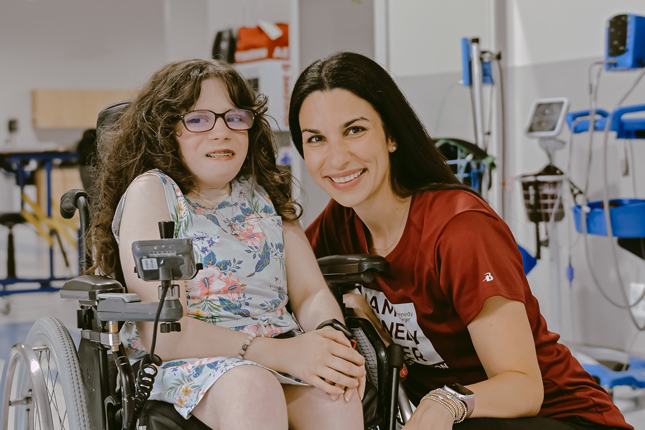
Abby is like many other 16-year-old girls. She loves singing and acting, adores animals and her favorite color is purple. But unlike most teenagers, Abby navigates the world with the help of an automatic wheelchair. And while that might be the most visible sign that her life is different from her peers’, it is far from the most challenging part of her journey.
Abby was born with Cerebrocostomandibular Syndrome, an extremely rare genetic disorder that affects the lower jaw and rib cage. She was born with a rib cage in multiple pieces, a cleft soft palate and tiny jaw. Her medical journey began with a tracheotomy at just five days old. Abby is also diagnosed with kyphoscoliosis. Without proper support from a fully formed rib cage, Abby’s spine twisted and curved as it grew. To date, Abby has had 42 surgeries – mostly on her spine.
Her journey with Kennedy Krieger began in the SCI Outpatient Orthopedic Rehab center in the fall of 2016, following spinal fusion surgery. She came back in winter of 2017 after another spinal fusion surgery – both of which ultimately failed.
Abby’s kyphoscoliosis worsened, pushing into her lungs. Her condition deteriorated and in 2020, Abby and her family drove to New York Presbyterian Hospital to try something drastic—a spinal halo with traction followed by multiple surgeries to fuse Abby’s entire spine together—a move that would hopefully prevent further bending and twisting.
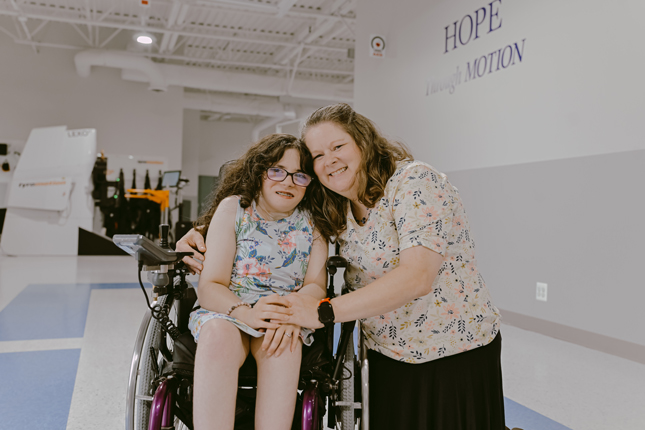
On December 17, 2020 during one of these surgeries, Abby experienced a spinal stroke at T3, leaving her paralyzed from the waist down.
“The doctors wanted us to do rehab there in New York, but they didn’t have a specialized spinal cord injury rehab,” said Julie Leach, Abby’s mother. “I put my foot down. I said no, we’re going to Kennedy Krieger.”
They made the trip back to Maryland, and Abby spent the next nine weeks in the inpatient unit of the Spine Center. Since then, Abby has continued outpatient therapy with SCI, as well as visits to the Bone Clinic and appointments with the wheelchair clinic for any equipment needs.
“Since Abby’s injury, the doctors and nurses at Kennedy Krieger have been with us every step of the way,” said Julie. “They’ve never told us she wouldn’t be able to live her life fully. They never put her in a box.”
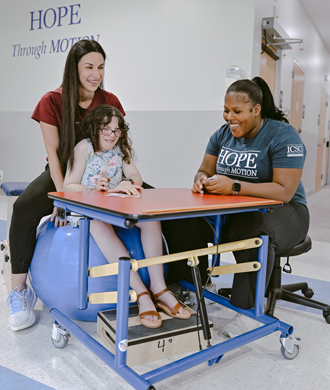
Julie has had a closer relationship to the doctors and nurses at Kennedy Krieger than anyone. When we asked her what she wanted people to know about Kennedy Krieger, she stated, “Kennedy Krieger walked every step with us. They email, check-in, and text. Our clinicians became our friends.” She elaborated, “The staff care about the whole child, not just the part that’s injured. They’ve listened and adapted as Abby has grown.” They’ve never felt rushed out of the room, and they both feel the culture of caring that comes down from the top. When you ask Abby the same question, she comments, “They remember me! They know who I am when I come back.”
Abby’s journey has been marred with challenges, negativity, and the unknown. But to meet her is to see the embodiment of perseverance, hope, and light. “People in wheelchairs can do what everyone else can do with a little hard work and determination,” said Abby. She is showing no plans of slowing down – acting in another musical and taking guitar lessons.