
This information is for investigators who are interested in utilizing the many resources that the F. M. Kirby Center has to offer. Specifically:
The Kirby Center review is integrated with the JHM eIRB!
All Kirby Center studies require advance approval by the appropriate IRB(s). All applications must be submitted via the Johns Hopkins Medicine IRB electronic IRB (eIRB) system.
Please note that, when submitting your protocol via the JHM eIRB system, it is essential that you list the Kirby Center as a performance site. This will enable the eIRB system to capture Kirby Center specific information, and to automatically route your proposal for review, as follows:
- The Protocol Review Committee (PRC) of the Kirby Center (for scientific review);
- The Kennedy Krieger Institute (KKI) (for risk/safety review);
- JHM-IRB.
[Note that the Johns Hopkins Medicine IRB requires KKI administrative endorsement of all proposals to conduct human subjects research at KKI, including Kirby Center projects by non-KKI principal investigators. KKI has chosen to so endorse only those proposals that have been approved by the PRC. The result of this is that new projects must be approved by the PRC before KKI will endorse them to the JHM IRB.]
In exceptional cases, the PRC may consider formal written requests for no more than five hours of "pilot" time. Such a request should state that no other funds are available to support the scanning, and should lay out plans to secure funding for further work.
Please note that our 3T scanners are FDA-approved medical devices; the approval documentation is available online (PDF). Please be sure to use the "MRI language" mandated by the JHM IRB, in your consent form.
When applying for grants, please use the rates on the page linked below. The rates reflect a fair estimate of inflation. As such, they are subject to change, but changes need to be approved by the Protocol Review Committee (PRC).
In April of 2009, the Kirby Center obtained a 7.0 Tesla human MRI scanner available for your use. This system represents a unique opportunity in neuroscience research within the Johns Hopkins community. The 7T comes with a 32-channel coil, and is equipped with fMRI presentation setup.
At this time, we would like users to consider expanding their existing protocols to add the possibility of scanning at 7T. This can be done with an amendment letter to the IRB. As a resource to help you make this request, we provide links to:
- Language for the eIRB system
- Language for the consent form
- The relevant FDA guidance
- Clinical Engineering Services approval letter
Note that the 7T supports:
- Multi-frequency transmit and receive
- Other coils:
- Cervical spine 1H coil (8-channel)
- 13C/1H loop coil (leg)
- 31P/1H head coil
- Interface boxes for home-built coils
Please do not hesitate to contact us with any questions.
Grant applications and competitive renewals that include magnetic resonance scanning at the F.M. Kirby Research Center for Functional Brain Imaging may support scanning costs through either a KKI subaward or direct billing.
Investigators who choose direct billing may do so without establishing a KKI subaward; however, scanning will be charged at the higher direct-billing rate.
Please note that adding a subaward will not change your direct costs (DC).
Although consortium costs (direct costs plus indirect costs) are displayed as direct costs in your grant budget, the total allowable maximum direct costs can be increased by the amount of the consortium's indirect costs. This allows you to retain the maximum allowable direct-cost budget. This applies to all NIH grants, including modular-budget applications.
For award annual continuations and new postaward requests JHU should send all copies of the subaward documents & exhibits they need to RPOsubawards@kennedykrieger.org and copy the KKI PI
Requesting a KKI Subaward
A KKI subaward requires a KKI site Principal Investigator (PI).
Projects That Include KKI Personnel
If the project team includes KKI faculty, an appropriate KKI investigator on the project should serve as the KKI site PI. The KKI site PI is responsible for initiating the subaward request through the KKI Pre-Award Initiator link and working directly with KKI Pre-Award on the application.
These subawards are handled through the standard KKI pre-award process and are not managed by the Kirby Center Administrative Services Coordinator.
Scan-Only Subawards
If the project does not otherwise include KKI faculty and KKI's involvement is limited to MRI scanning at the F.M. Kirby Research Center, the application may be submitted as a scan-only subaward.
The Kirby Center can help identify an appropriate KKI site PI for scan-only subawards. To initiate this process, please email the Kirby Center Administrative Services Coordinator, Emily Galbraith (Galbraith@kennedykrieger.org).
Please provide all of the information listed below separately and explicitly, even if some of the information is available elsewhere in the application package or supporting documents. Providing the information in one place helps reduce administrative burden and minimizes the risk of errors or inconsistencies during subaward preparation.
- Full project title - Enter the title exactly as it will appear in the grant application. If the title changes or is still to be determined, please notify us.
- Grant short title/reference - Optional.
- Grant period (start and end dates)
- A short paragraph describing the project.
- Lead institution - For example, Johns Hopkins University or the University of Maryland.
- Lead PI - First and last name.
- Proposal Type - new, renewal, pre-proposal LOI requiring institute signing official, supplement, resubmission, or other.
- Category - research, community based, early child development, instructional, clinical trial, construction, pre- or post-doctoral fellowship, or other.
- Sponsor/Funding Agency - For example, NIH or DoD.
- Solicitation/RFP identifier - For example, an RFA or PA number.
- Solicitation/RFP URL - Optional.
- Sponsor deadline.
- Lead site deadline – The date by which the lead institution requires the completed KKI subaward package.
- Whether the project involves human research, animal research, or both.
- For human scans, whether the study will use contrast - no contrast, a single dose, or a double dose.
- Any other Center resources or services you expect to use.
- Any additional information or documentation required for the application.
MRI Scan Information
For the MRI scans, please provide a table similar to the following, with one row for each project year and a final total row. If more than one scanner or other MRI equipment is being used, please provide a separate table for each.
[Scanner to be used]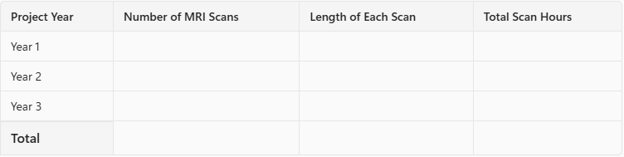
Please add or remove project-year rows as needed to reflect the full project period.
If you do not receive a response within two business days, please contact the Kirby Center Assistant Manager at ChoeA@kennedykrieger.org.
Subaward Review Timeline
All KKI subawards require internal review by KKI. KKI requires at least 15 days before the Johns Hopkins University internal deadline to complete this review. Please plan accordingly when preparing your grant application.
If the pre-award process needs to be initiated after the applicable deadline, the KKI site PI must contact PreAward@KennedyKrieger.org directly. The request must include an explanation of why the deadline was missed, such as an RFA being issued late. The ORASP Pre-Award team will make every effort to support planned applications. However, late requests will be considered based on overall submission volume, the complexity of the application, the application's overall preparedness, and the submitting faculty member's history of meeting deadlines.
Questions
For questions regarding a scan-only Kirby Center subaward, please contact:
Kirby Center Administrative Services Coordinator, Emily Galbraith Galbraith@kennedykrieger.org
And copy the Kirby Center Assistant Manager, Dr. Ann Choe ChoeA@kennedykrieger.org
For questions regarding a KKI subaward for a project that already includes KKI personnel, please contact the project's KKI site PI and follow the standard KKI Pre-Award Initiator process.
The neurobehavioral research unit (NBRU) is part of the ICTR (previous GCRC) and can provide pilot funding for MRI data acquisition and data processing.
Websites:
- NBRU
- Application Details: http://www.hopkinsmedicine.org/gcrc/application/process.cfm
All human subjects research at the Kirby Center requires prior approval of an Institutional Review Board (IRB). Some IRBs, including the Johns Hopkins Medicine IRB, require that images that are of clinical quality be reviewed by a neuroradiologist for incidental findings. When this is the case for a study, the study PI is responsible for requesting that Kirby Center staff transfer the appropriate images for these readings.
As you may be aware, one goal of the Center is to provide state of the art equipment and technology to you. This requires proper maintenance and upgrading of the systems, which is very expensive. When a system has to be replaced, we have been fortunate to obtain NIH funding for that. Specifically, the recent replacement of our first 3 Tesla scanner (MR2) was funded by a high end instrumentation grant from NIH. In line with NIH rules, we now have to acknowledge that award to document the use of this scanner. As you may understand, this is crucial for us to be able to keep getting these grants in the future. So in your papers based on data from the new scanner, can you please add the following acknowledgment. “The MRI equipment in this study was funded by NIH grant 1S10OD021648”. It would be great if you could also add this to the PMC (NIHMS) version of your papers. We apologize for this extra work, but hope you understand the importance of this. Thank you.
The Kirby Center offers intravenous contrast agents (chelated gadolinium) contrast. Pricing is as follows:
- $110 for a single dose (1 vial) and 1 syringe
- $170 for a double dose (2 vials) and 1 syringe
- $190 for a double dose (2 vials) and 2 syringes
- $25 for off-site Creatinine testing.
Please note that, like other Kirby Center procedures, the use of IV contrast must be approved by the IRB.
In Fall of 2009, KKI received clarification regarding urine pregnancy testing within human subjects research projects, which was verified with the State of Maryland Laboratory Administration. If the results of a urine pregnancy testing are being used for screening for study inclusion, the testing must be performed under a CLIA (Clinical Laboratory Improvement Amendments) license, even if the research team does not share the results with the participant.
From this point forward, based on these CLIA requirements, research applications that include pregnancy testing procedures require either: (1) urine pregnancy testing using a CLIA certified laboratory such as the Johns Hopkins Medicine (JHM) Pathology lab, or (2) waived/point-of-care urine pregnancy testing in an institution with a CLIA license. The Kennedy Krieger Institute does not have a CLIA license for waived/point-of-care urine pregnancy testing. Waived testing for KKI protocols may be done at one of the JHH clinical research units (adult or pediatric, in-patient or out-patient). For more information on the Johns Hopkins Clinical Research Unit services and application process, please go to http://www.hopkinsmedicine.org/gcrc/.
The JHM pathology lab offers specimen processing and diagnostic testing at a reduced price for research studies. Research discounted pricing applicable to a study account in Pathology can be obtained by sending a list of required study tests to bfilburn@jhmi.edu (phone 410-955-2661, fax 410-955-5961) or to jnash1@jhmi.edu (phone 410-287-5197, fax 410-955-0394).
Using the JHM Pathology lab will require the research participant to have or register for a JHH medical record number. Some research participants who live in this area may already have a JHH number. For KKI research participants who are not clinical patients and require lab testing, the study team should call ahead of the scheduled study visit and request a JHH number for a research participant. The KKI person to call to request a JHH number is Debbie Simpson at (443) 923-2613. The JHH office number is (410) 955-6262. The required information includes: patient complete name, DOB, home address, mother's maiden name, and social security number. JHH may require additional information. Having the information ready at the time of the request will expedite the process.
If you are a funded investigator who wants to extend your research into the field of neuroimaging, and you need help conceptualizing, planning, or implementing your experiments, please feel free to contact Dr. Mike Kraut, head of the Neuroimaging Core of the Intellectual Developmental Disabilities Research Center (IDDRC) at the Kennedy Krieger Institute. Under the auspices of the IDDRC, you will find faculty with expertise in anatomic, spectroscopic, and functional neuroimaging. Mike will talk with you about your plans, and direct you to the person who will likely be of the most help. Mike Kraut can be reached at (410) 955-6593 (office), or by email at mkraut1 at jhmi dot edu.