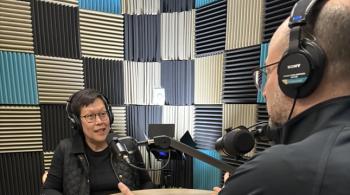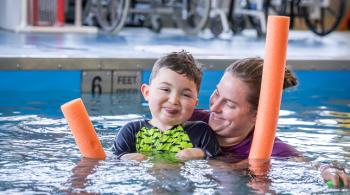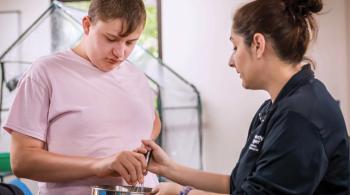
About 1% of all children in the U.S. have multiple significant and chronic health problems, or what’s known as “medical complexity.” Kennedy Krieger happens to be a leading treatment center for children whose medical complexities affect the brain, spinal cord, nerves, or muscles. In this episode, Dr. Michelle Melicosta, associate chief medical officer, explains what medical complexity is. Listeners also meet Eleftheria Tzortzakaki, the mother of a young patient with acute flaccid myelitis, a condition that is both rare and complex. As always, Dr. Brad Schlaggar, president and CEO, serves as host.
Learn More About Kennedy Krieger Faculty & Staff Members Featured in This Episode
Michelle
Melicosta
,
MD, MPH, MSc
Dr. Bradley Schlaggar (BS): Welcome to your child's brain, a podcast series produced by Kennedy Krieger Institute with assistance from WYPR. I'm Dr. Brad Schlaggar, pediatric neurologist, and president and CEO of Kennedy Krieger Institute. About one in five or 20% of children in our nation have an ongoing or special healthcare need, including diagnoses like asthma, diabetes, ADHD, and other common conditions for which treatment and access to care while variable are for the most part reasonably available across the nation. However, within the group of children with special health care needs, within this 20%, there is a subset of patients for whom we use the term children with medical complexity. This group, representing about 1% of all children in the US, includes those who have multiple significant chronic health problems and functional limitations, with high health care resource needs, and many of these children rely on medical technology devices such as feeding tubes or home ventilators for breathing to improve or sustain life in daily function. It's important to emphasize that one of the significant consequences of the success of acute pediatric care over the last several decades makes survival possible for children with what had been life shortening or life ending illnesses and injuries, but it has increased the number of children living with chronic complex medical conditions. These young patients, about 1% of all children, account for about 1/3 of overall health care spending for children and make up an increasingly large proportion of children requiring care in acute pediatric facilities, including in intensive care settings. Equally important to note is that children with chronic medically complex conditions are surviving into adulthood at a higher rate than in previous generations. When we talk about caring for them, we also must acknowledge the need to enhance our systems of care to support these individuals across the lifespan. Now, by the nature of our work at Kennedy Krieger, which is to care for individuals with diseases, diagnoses, and injuries that affect the nervous system. That's the brain, spinal cord, nerve, and muscle, especially in children, we are also expert in caring for children with medical complexity. Much of what happens in the nervous system impacts the rest of the body, and we see children with complex medical conditions in both our inpatient and outpatient programs, as well in our school and early childhood programs. Joining me today to talk about the care and treatment of children with medical complexity is Dr. Michelle Melicosta, Associate Chief Medical Officer, and the Vice President of Quality, Patient Safety, and Professional Affairs at Kennedy Krieger, and Dr. Melicosta is also an assistant professor of pediatrics at the Johns Hopkins University School of Medicine. Also with us today is Eleftheria Tzortzakaki, parent of Leo, who is a young man who's living with a condition called Acute Flaccid Myelitis. Welcome to both of you, and Michelle, in the introduction, I framed the topic of children with medical complexity rather broadly, but what else would you add to set the context for our discussion today, including perhaps broadly addressing whether these conditions are primarily congenital or acquired or some combination.
Dr. Michele Melicosta (MM): Thanks. Yeah. It is definitely a combination. Although most recent reviews are finding that just over half are attributable to genetic diagnosis. Others are acquired conditions, either due to prematurity, to injuries or infections, particularly those that impact the brain or spinal cord or to chronic conditions such as severe epilepsy. As you mentioned, we've seen huge advances over the past couple of decades in NICU care for both premature infants and those born with significant structural abnormalities, as well as in survival after trauma and cancer treatment, and while this is fantastic, it has also increased the number of children living with chronic complex medical conditions, the proportion of inpatient admissions who are children with medical complexity, and the need for us to expand services to those patients.
BS: Yeah, no question, and just I know over our own time in medicine from times we were in training 30 or so years ago to now, it's remarkable the shift that has happened in the survivorship of so many patients that previously were not able to survive. Michelle, how does this medical complexity affect a child's development? Are there factors that determine the extent of that impact?
MM: Children with medical complexity have been found to be at increased risk, both of neurodevelopmental and also mental health conditions. Just under half of all children with medical complexity have at least one neurodevelopmental diagnosis, and a 1/3 have one or more mental health diagnoses. Medical complexity impacts developmental trajectories both directly due to the underlying conditions that might impact the developing brain, as well as indirectly. These children often have repeated and prolonged hospitalizations, which can cause plateaus and sometimes even regression in development. The most common mental health diagnoses in these children are often medical trauma related disorders and anxiety disorders, and when they're not in the hospital, they often have multiple medical therapy appointments that make typical childhood routines feel really out of reach, and they face barriers to school and peer engagement due to their health care needs and the lack of accessibility sometimes in these spaces. In terms of the factors that impact this, the more types of technology dependence and the greater the number of involved body systems, the more likely that child is to also have a neurodevelopmental diagnosis, and what this means for health care providers is that when a child has a change or a regression in their behavior, we need to be thinking about potential medical and developmental and mental health causes. For example, a child who has communication challenges may display challenging behaviors due to pain from otherwise silent infection or constipation or worsening spasticity, or they could also be having the initial manifestation of a mental health issue or a developmental regression, and despite the increased prevalence of neurodevelopmental disorders in children with medical complexity, these kids have been shown to be at risk for delayed diagnosis of developmental problems and thus delayed access to the care that they need. The American Academy of Pediatrics recommends periodic screening for developmental issues, but this can get lost during a primary pediatrician's visit when there's so many medical issues to cover.
BS: Michelle, I mentioned that and I know you'll agree that as medical science continues to progress, and more and more children with complex conditions are actually surviving into adulthood. What are we doing to support these individuals across the lifespan?
MM: Yeah, that is actually a huge issue right now. There's national attention to both the workforce issues, funding issues, and just the need for expanded care options as these children transition to adulthood. This has been championed by groups like the American Academy of Pediatrics, and also by many family led advocacy groups for particular conditions, who I see really active in this space as they watch their children age out of services. I'm seeing an increased number of physicians who are trained in both internal medicine and pediatrics also working in this space, and here in Baltimore, our neighboring complex care clinic is headed by a Med-Peds physician for just that reason. We also building educational and collaborative efforts with primary care providers in the community. I've been involved with some MDAP talks that have been given to non pediatricians to help them become more familiar with caring for adults with some of the conditions that have previously been seen in the pediatrics world, such as congenital heart disease and down syndrome, and here at Kennedy Krieger, we have multiple specialty clinics, of course, where we see patients across the lifespan.
BS: Yes, there's increasing numbers of individuals training in medicine and pediatrics, we call it Med-Peds as a pathway. That's still a small number, and what I think you'll also agree on is that many disciplines, really across the discipline space, need to recognize that whether you're a surgeon or an OBGYN or an ophthalmologist, regardless of where you're working, because the prevalence of individuals with these chronic complex conditions is high and getting higher. No matter where you are, you need to be trained to be able to work in this space?
MM: Yeah, absolutely. I speak primarily within the medical space because that's where I'm most active, but we are absolutely seeing similar initiatives among therapists, among nursing, again, among some of these interdisciplinary groups, looking at just doing a better job in coordinating care and often partnering with groups like our own project heal. How do we support young people's legal rights and educational rights as they transition to adulthood with medical conditions. All of that space is really important.
BS: You mentioned Project HEAL that's Health, Education, Advocacy, and Law. This is a medical legal partnership, 20 plus years in existence at Kennedy Krieger, that does just as you say, and it's that scaffolding that's necessary in many domains to really address the needs of individuals across the lifespan. Along these lines, many probably don't know that a major part of what we do at Kennedy Krieger is training clinical professionals, and that includes the education for current medical students, pediatricians, different specialties and providers in the communities, including across the country. I'd ask you, I know you've been engaged in work focusing on this patient population at the national level that you reference. Can you dive in deeper on what you've been doing in that space?
MM: I really began engaging with educational efforts beyond Kennedy Krieger when I was asked to develop the Complex Care chapter in the KIND Curriculum, which is online resource that's housed here at Kennedy. After doing that, it became really apparent to me how much interest and how much need there was in this area among providers, and again, I mean multidisciplinary providers nationally. Since then, I've spoken nationally on this population, and I'm currently leading the American Academy of Pediatrics revision of our clinical guidelines on the care of children with medical complexity, and the intent of that is to not only provide guidance to those in practice, but also hopefully to inform training requirements and healthcare financing policy.
BS: Eleftheria, we're so very glad you were able to join us today of all days because I think if I understand correctly, today, the day the recording is actually Leo's birthday, so happy birthday to Leo. I think he turns 11 today, and so we'd love for you to tell us more about Leo.
Eleftheria Tzortzakaki (ET): Thank you for your invitation, first of all. Leo now is 11-years-old. We came here, I think it was Halloween day of 2019. He was 4.5-years-old. He didn't know any word in English. All the staff of Kennedy Krieger taught him everything, day by day. He got sick suddenly on November 2018. We were in Greece. He just had a low fever and running nose. The doctor there in Greece didn't worry at all. He was okay, nothing. Just a cold, just be patient, wait. But he suddenly lost his movement and the third day he lost his breath. We were to the ICU in Greece. The doctor there didn't have any experience, didn't know what's going on. For more than three months, they keep telling us, just be ready for everything. It was really hard. It was really sad for us for Leo, and after three months, he started thinking about the next steps. After six, seven months in Greece, and ICU in Greece, and ICU in Greece, it's really hard. You cannot stay with your babies, your kids. You just have to see them just half an hour per day. He didn't have his own room. He just has between the kids cartons. He was able to hear everything. It was really bad. After 11 months, the doctor discussed and think to search about Europe, America, and so we try, we search a lot. We sent different emails to the national office, and only Kennedy Krieger accept us. For us, it was really helpful. I was really happy, and suddenly we came to America. It was really hard for me and for my husband to prepare everything to have our visa, but Kennedy Krieger was always next to us via phone, the international office, the ladies there keep calling me, and we had communication via email. My English, they are not correct. They still not correct, but they have a lot of patience. We came here. We spent four days to Hopkins, and because of the pacemaker and then direct to Kennedy Krieger. The Kennedy Krieger for us, it was really like a home. Leo has huge doctor team care team, but our family is from Kennedy Krieger. They are not only doctors for us. They were always next to me and to Leo. Leo create for every single patient nicknames. Dr. Melicosta knows.
BS: Well, Eleftheria thank you for sharing that with us and the journey that you've been on, and I'm so glad we've been able to be with you along the way. This is this diagnosis of acute flaccid myelitis, and I'll ask Michelle to comment on that in a bit. But if you could speak to how is it affecting him now? What's Leo's life like right now?
ET: It's hard to have disabilities, but Kennedy Krieger they never say no. Leo, do you want to play? Let's play. Do you want to go there? Yes, let's go. You cannot use the stairs, but we have other way. That makes Leo more comfortable, more proud of himself, and they built his psychology. When we came here, Leo doesn't want me or his daddy to be far away. Not only far away. He wants to us to touch him. We spent more than three months with the child life with our doctor with psychology team to help Leo to feel safe and proud of himself. Leo, you cannot move, but you can speak. We have wheelchair. We have power chair. Let's do it. Continue. Yes, you can. Do you want to go to do bike? Let's do bike. Do you want to play play station? Because he love it. Yes, Let's play different way, but they play.
BS: You mentioned that he has a very large team, and he has nicknames for all the members of his team. But can you speak a bit to who are those team members? What different types of doctors and specialties, different types of therapists? Can you tell us about that?
ET: At Kennedy Krieger, he has Dr. Melicosta. He always called her doctor Meli. Meli in Greece means honey. Dr. Meli, he has his nurses, of course, the respiratory therapist. He has the therapist, PT and OT. He has a psychologist, and he has his favorite team, the Child Life team. That is the best of the best part of Kennedy Krieger. They are amazing, and they try, they are always happy. They were always next to him, before the surgeries, before them with his follow ups appointments, he always had someone except me, someone next to him to play with him, to talk with him, and it's really for me as a parent is really helpful and supportive that they have like file. Leo. This is Leo. He's 11-years-old. He likes this, this, and that, and they know him. They know him, and they know every single detail of him. Of course, he still has the same person, but every new person that they added on his team, they already know. Leo likes football. Let's prepare something. They made millions of surprises for him. Field trips, they decorate his room. They I just have to say the best for everyone.
BS: It's hard. One cannot understate the importance of the role of child life and therapeutic recreation. It's real medicine. It changes day to day, and it changes outcomes, and we are very fortunate at this institute to have a deep and expert team in child life and therapeutic recreation. Thank you for highlighting that. Michelle, if you could just comment real quickly on, what is acute flaccid myelitis?
MM: Acute flaccid myelitis is like the name says, It comes on very suddenly, just like it did with Leo usually over hours to days, and it's damage to the motor part of the nerves in the spinal cord that causes a flaccid paralysis, meaning the patient can't move, but they don't have spasticity, and their sensation is preserved. That in and of itself can cause trauma and anxiety for children who can feel everything that's happening to their body, but can't control their body anymore. It has been shown to affect people even up through young adulthood, but primarily the bulk of patients are pre-adolescent children, and so that experience of suddenly not being able to walk or feed yourself, but still feel what everyone is doing to you and still feel pain, I think is makes AFM particularly challenging when we're working with young children.
BS: For those listening to that description, It sounds very much like, and it is very much like what was seen in another era and Poliomyelitis, the same condition and the clinical presentation of it. It's a rare condition. It's acquired, as you're saying, and it is one of the complex chronic conditions that we do see at the Institute. This next question is really for both of you, and Michelle, maybe go first. Let's talk about preparation for Leo for his discharge from the hospital and his return to community life. What's involved in that? Michelle first and then Eleftheria?
MM: It is a huge team effort. Our goal when children leave the hospital is number one to have them be safe at home, and then right after that, being able to participate in their school and family and community life to the greatest degree that they can. That means providing parent education, so the parents feel comfortable providing the cares that the child needs at home. Child Life, like you just mentioned, helping to prepare the child for what it will be like. Going home, going back to school, being in a wheelchair, and then also working with the case managers, home health nurses, DME, companies, social workers, outpatient therapies, outpatient physicians to help make sure that the medical care and the therapeutic care continues, and then the huge role of our education specialist in navigating re-entry to school, particularly with children who go home on a ventilator, often need a nurse to go to school with them and making sure the school setting has everything they need and that they feel supported in having that child there so that they can focus on education and know that the nursing staff is going to look after the child's well being. It is a huge team effort, for sure.
BS: Eleftheria.
ET: I can tell you, of course, my experience. Because of the pandemic and because we didn't know if we would be able to stay more in USA. Then we discussed because Leo needs more therapies. We discussed to stay almost 10 months, several months as a inpatient, and then when it was time to go back to real life, and Dr. Melicosta knows that I was really scared about that. We find a house and one team like from social worker, PT therapist, and I remember, it was two more persons that they came at home and they want to check everything. The main entrance, the electricity, the power. Actually, they not decorate. They told us where Leo has to be from which entrance has to go in and out, they taught us a lot. They prepare everything. They communicate with the fire department. Another department contact with the school for the registration, Kennedy Krieger. They did everything for us. It's not only the doctors. They help us a lot. I never have to worry about anything. I just have to communicate with them. I just sent an email and they call me back or send me an email, and this year, actually, we moved to another house, and we had to switch to another school, and Leo had really difficult time and hard time to use the new environment, the new students, and I remember one lady from Child Life called me that it was 1.5 week that the school started and asked me, how is Leo? Can you talk to him and they had a Zoom meeting. Only Leo and Ms. Emily. She asked him a few things and she didn't like the answer that Leo gave to her. Then she told me, look, I don't like Leo's answer. Do you allow me to contact with the school? That's it. Kennedy Krieger contact with the school. They had few meetings, and then everything is perfect now.
BS: That's very, very good here. Again, I'm so grateful for your comments and that we've been able to be with you and Leo and your family along this journey. Michelle, what do you consider to be on the horizon for the care and treatment of children with medical complexity that you find exciting and promising and energizing?
MM: I think there's two big areas that I'm really excited about. The first is that I'm seeing a lot of experimentation, if you will, with different care models. Structured care coordination models like the Complex Care for Kids Initiative, out in Ontario. There's the Indiana Complex Care Coordination Collaborative. There's some rural models, both in Texas and in upstate New York, and all of these are really focusing on interdisciplinary coordination, but tailoring to local resources and conditions. I just think the work that's being done in that space is really exciting. Secondly, I'm thrilled that there's more recognition of the importance of education around medical complexity for our trainees. Like you've mentioned, these children are an ever larger proportion of our hospital admissions. Our trainees need to get exposure, need to get prepared to deal with them. There's been a number of new cross disciplinary fellowships announced recently, and next month, we're actually have a national group meeting up in Boston to brainstorm how we might re-envision health professions education. Again, with that focus on the whole lifespan.
BS: Well, that's a great place to end. I want to thank our guests, Dr. Michelle Melicosta, and Eleftheria, Leo's mom, for joining us today and sharing their insights, and I hope our listeners have found today's discussion to be both interesting and informative, and that you'll share this podcast with your friends and family and rate us if you're so inclined. Please check out our entire library of topics on your child's brain at wypr.org, KennedyKrieger.org/ycb or wherever you stream your podcasts. You've been listening to Your Child's Brain. Your Child's Brain is produced by Kennedy Krieger Institute with assistance from WYPR and producer Mark Gunnery. Please join us next time as we examine the mysteries of Your Child's Brain.