
Outcome-Changing Research on Sturge-Weber
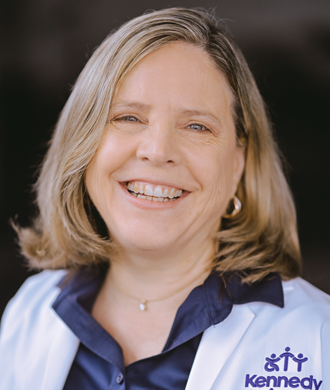
Syndrome Sturge-Weber syndrome is a rare neurological condition affecting the development of the capillaries in the skin, eyes and brain. Early in her career, Dr. Anne Comi—a pioneer advancing the field of vascular anomaly research—discovered that, for children who are born with Sturge-Weber syndrome, there is a window of opportunity for physicians to intervene, slowing or halting the syndrome’s progression with treatments.
Sturge-Weber, while genetic in origin, is not inherited. Rather it occurs randomly, affecting males and females equally.
A hallmark symptom is a port-wine stain birthmark, at birth, on one side of the face around the eye or forehead. Other symptoms are seizures and convulsions, glaucoma, stroke-like episodes and headaches. Brain injury often results, producing motor and cognitive impairments.
“Children are born with the birthmark, but don’t develop neurologic symptoms for months or even a year later,” Dr. Comi explains. “That is an unusual situation, to have something that so clearly indicates risk at birth before issues really start to develop.”

Discovering the Genetic Basis for Sturge-Weber Syndrome
Discovering the cause of Sturge-Weber syndrome had long challenged scientists.
In 2005, in memory of a young boy with SWS who died from SUDEP (Sudden Unexpected Death in Epilepsy) and driven by a commitment to uncover the cause of the disorder and improve clinical care and patient outcomes, Dr. Comi established the Hunter Nelson Sturge-Weber Center—an interdisciplinary hub for research and optimal patient care.
For several years, they saw patients and immersed themselves in the clinical and scientific aspects of the disease. They gathered a large bank of tissue samples from the Maryland Brain and Tissue Bank and the NIH-funded NeuroBioBank to test Dr. Comi’s theory that Sturge-Weber was genetic, but not hereditary or the result of a prenatal event like a stroke. “I just knew clinically that if it was genetic, it had to be somatic [the body’s non-reproductive cells],” she explains. “It just had to be. And it is.”
In 2013, Dr. Comi led colleagues in a breakthrough discovery. After whole-genome sequencing—a process at that time that was so cost-prohibitive that they were only able to fund the sequencing/ comparison of three patients’ DNA—they identified the culprit gene GNAQ on chromosome 9. They spent months validating their results. “It immediately became my goal to develop models for Sturge-Weber syndrome,” Comi says. Following this ground-breaking discovery, Dr. Comi and her Kennedy Krieger collaborators conducted functional studies to understand how the GNAQ gene mutation leads to overactivation of the ERK signaling pathway. This overactivation causes excessive phosphorylation of ERK, a process that can disrupt normal cell behavior and lead to changes or damage in other cellular structures. Their ongoing work is improving the early diagnosis and treatment of brain involvement in Sturge-Weber syndrome, essential research to prevent ischemic brain injury in infants and young children.
In 2024, Dr. Comi and researchers at Boston Children’s Hospital discovered a new way to decrease early likelihood of seizures and improve neurological outcomes by age two in infants with Sturge-Weber syndrome through pre-symptomatic treatment. This groundbreaking discovery will impact the quality of life for young Sturge-Weber patients.
“By treating these infants ahead of time, we can lower those chances of experiencing early seizures by almost half,” says Dr. Comi. In addition to presymptomatic treatment, researchers also found that conducting a clinical electroencephalogram (EEG), a test that measures electrical activity in the brain, can predict seizure onset. Dr. Comi believes these results will change treatment approaches across the globe. “Stopping the seizures ahead of time means we lower the risk of brain injuries,” Dr. Comi said.
Later in 2024, Dr. Comi and her team published groundbreaking laboratory findings on Sturge-Weber syndrome, positioning the research program to significantly advance our understanding of how the GNAQ mutation leads to abnormal blood vessel formation and seizure susceptibility. These insights now enable the testing of novel, potentially disease-modifying drugs and gene therapy strategies in a controlled laboratory setting.
Transforming the Treatment of Sturge-Weber Syndrome
Kennedy Krieger is the world’s premier healthcare organization dedicated to improving the lives of children and young adults with care and research focused on disorders and injuries of the developing nervous system, from autism spectrum disorder and intellectual disability to Batten disease, cerebral palsy, acute flaccid myelitis and more than 200 ultra-rare diseases.

That means we are comfortable in uncharted territory. In fact, it’s where we do our best work. Kennedy Krieger has a long history of undertaking and harnessing groundbreaking scientific research, conducting world-class clinical trials and creating new treatments to change lives.
Dr. Comi’s lab group is changing the future for children born with Sturge-Weber syndrome and other vascular anomalies. Currently, they are developing and testing gene therapies to create what will be the first-ever drug therapy and novel approaches to treat—and ultimately cure—the disease and related brain injuries resulting from impaired blood flow to the brain.
Through the discovery that almost all vascular anomalies are caused by somatic mutations, not inherited, Dr. Comi and her team have changed the field of vascular anomalies. Their pioneering research continues to expand treatment possibilities, shaping the future, and most importantly, changing the future of children with rare diseases.
We’re now at a point where we can begin predicting who is most at risk, even before the first seizure. This opens the door to starting treatment earlier. It could change the entire path of a child’s development.” – Dr. Comi