






Educational and Learning Disabilities Research*
Participate in Research Studies
Kennedy Krieger Institute is a leader in learning, communication, cognitive disorders and educational research, spanning disciplines from basic neuroscience through clinical science and education. Several educational research projects at Kennedy Krieger also participate in NICHD funded projects.Current educational research projects listed below range from a collaborative research effort with the Haskins Laboratories and Educational Testing Service to investigate the educational and neurobiological underpinnings of reading disabilities in adolescents, to a longitudinal investigation of mathematics skills in youngsters with math disabilities.
Reading research now has it's own website. Click here to visit http://readingresearch.kennedykrieger.org/.
Being able to read is a fundamental skill that affects all areas of a person’s life. Difficulty with reading and reading comprehension has serious consequences. It is not only a sign of how well a student will do with school, but it can influence the types of jobs offered and whether future educational goals are attainable.
Research has shown that:
- Approximately 15-20% of beginning readers (K-3) have poor word reading skills (poor decoders).
- Approximately 10-25% of older readers (10 years and above) have normal word reading abilities although they have problems with comprehension.
- This is about 3% of the school age population.
However, less research has looked at understanding what other skills (in addition to word reading) are essential for reading comprehension. This is an important area of research, especially for children who have problems with comprehension despite normal word reading ability.
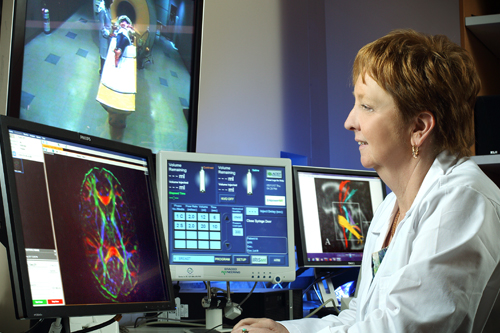
Furthermore, there is a small yet growing body of literature with the primary focus of studying how the brain processes information during comprehension tasks. The purpose is to see whether differences exist between readers of varying ability and if these differences can change after receiving reading instruction.
The ultimate goal of the National Institutes of Health (NICHD, NINDS) - funded reading-related research at Kennedy Krieger Institute is to:
- Identify the strengths/weaknesses of struggling readers across a variety of skills;
- Identify the tests that will be the most accurate at identifying these readers; and
- Most importantly, identify reading interventions that will help these struggling readers and get them reading at their full potential.
- I would like to learn more about becoming a participant in a reading research study of children and adolescents at the Kennedy Krieger Institute.
- I would like to learn more about becoming a participant in a reading research study of young adults at the Kennedy Krieger Institute.
- I would like to learn more about becoming a participant in an intervention research study of children and adolescents (ages 7 through 16) at the Kennedy Krieger Institute.
- I would like to learn more about having my school/school system involved with reading research at Kennedy Krieger Institute.
Neurofibromatosis Type 1 (NF-1) is a genetic disorder that affects the nervous system. NF-1 occurs in 1 out of 3,000-4,000 people worldwide.
NF-1 is commonly characterized by physical characteristics:
- Skin color changes (café-au-lait spots)and excess freckling;
- Tumors along nerves in the skin, brain, and other parts of the body (multiple neurofibromas);
- Tumors that grow along the nerve leading from the eye (optic gliomas); and
- Bone deformities (scoliosis).
While studies have investigated the strengths and weaknesses of people with NF-1, there is not a clear understanding of why there are problems with reading. Additionally, it is not well understood whether children with NF-1 should receive the same types of reading interventions as children without this disorder who struggle with reading due to the complexity of the disorder.
The National Institutes of Health (NINDS) - funded research at Kennedy Krieger Institute is aimed at studying children 7 through 16 years old to find out:
- Whether differences really do exist between individuals with NF-1 and struggling readers without NF-1;
- Whether there is a neurobiological basis, or differences in how the brain is used, when trying to read; and
- What types of reading instruction are the best for helping children with NF-1 read at their full potential.
- I would like to learn more about becoming a participant in a research study of children and adolescents with NF-1 at the Kennedy Krieger Institute.
- I would like to learn more about other reading research studies going on at Kennedy Krieger Institute and how I can be a research participant.
| Title: | |
| Sponsor: | National Institute of Child Health and Human Development, National Neurofibromatosis Foundation, 1998-99, Neurofibromatosis Foundation Inc., - Mid-Atlantic Chapter (2000-01) |
| Principal Investigator: | Michele M. M. Mazzocco, Ph.D. |
Math Skills Development Project is a longitudinal study of math ability and achievement during the early school years. The broad, long term objectives of this project are to contribute toward understanding early math ability, math disability (MD), and MD subtypes. We are interested in knowing how cognitive, behavioral, and genetic factors contribute toward successful mathematics achievement. We are also dedicated to understanding the different processes associated with poor math achievement, and to identifying early indicators (in kindergarten or first grade) of later poor math achievement.
·Robin P. Church, Vice President for Educational Programs
·Laurie E. Cutting, Ph.D.
·Martha Bridge Denckla, M.D.
·Michele M. M. Mazzocco, Ph.D.
·Laurie E. Cutting, Ph.D.
·Martha Bridge Denckla, M.D.
·Michele M. M. Mazzocco, Ph.D.